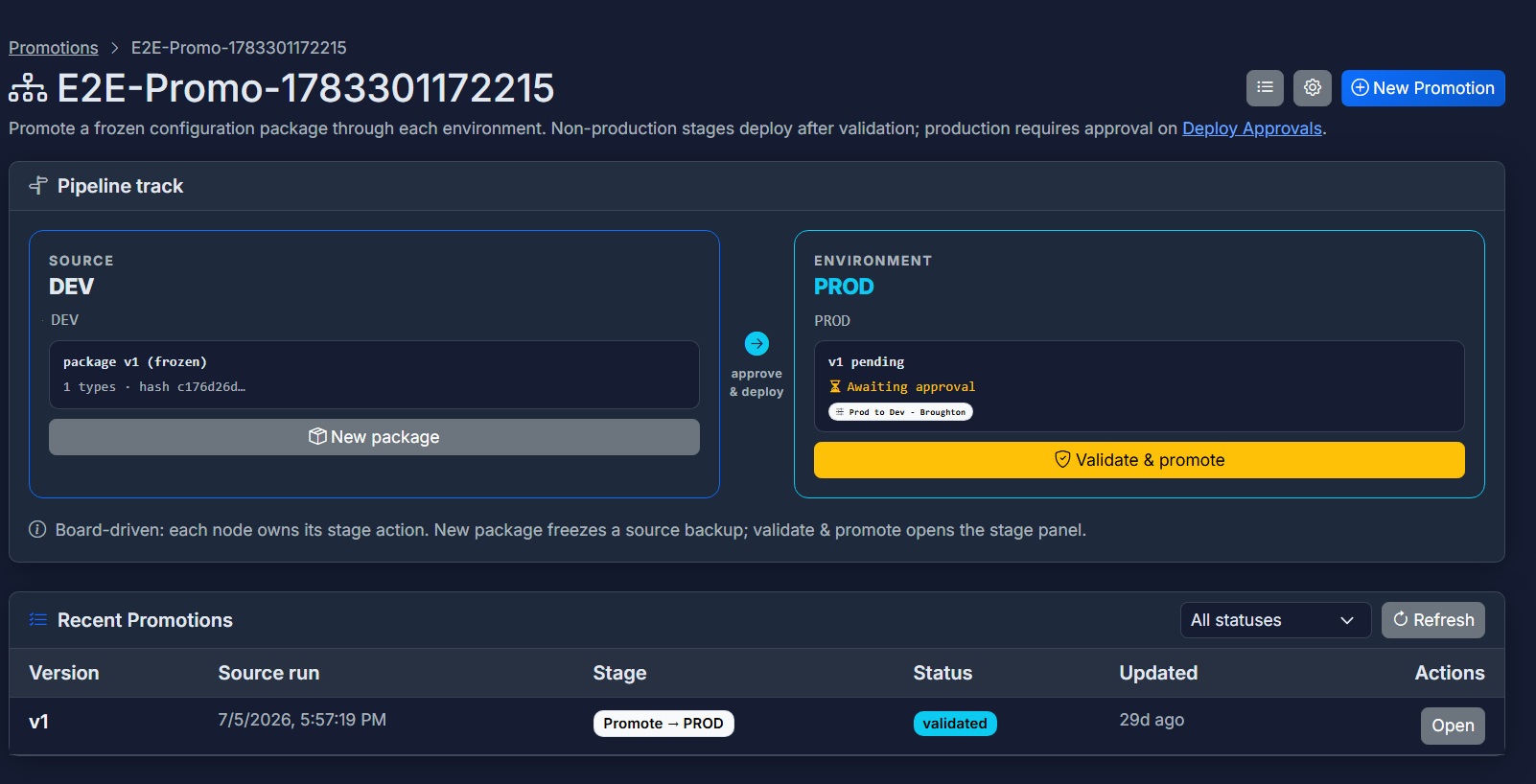
Why Five9 promotion needs a pipeline
Most Five9 teams promote configuration the hard way: someone reads a runbook, rebuilds the change by hand in UAT, and rebuilds it again in PROD — hoping nothing was missed, renamed, or fat-fingered between environments. Every hop is a fresh chance for drift, and the “evidence” of what shipped is a spreadsheet and someone’s memory.
Software teams solved this decades ago: build once, promote the same artifact through every environment, gate production behind review. 9Vault brings that discipline to Five9 configuration. A change is captured once as a frozen, versioned package, and that exact package moves through your environment chain — validated, diffed, approved, and logged at every step.
How a Relay pipeline works
-
Freeze & validate
Capture a source backup as a versioned package with a release label. The package is immutable — what you tested in DEV is byte-for-byte what lands in PROD, not a re-keyed approximation of it. -
Promote through DEV and UAT
Replay the same frozen package on each intermediate environment. Before every hop, preflight analyzes dependencies object by object, and a profile-aware diff shows exactly what will be added, modified, or left untouched — so surprises surface in the gate, not in production. -
Gate PROD with Deploy Approvals
Production promotions become approval requests with separation of duties — you can never approve your own change. Approvers get the full picture: the request snapshot and timeline, a one-page AI-generated CAB brief covering frozen scope and IVRs touched, and deterministic evidence exports (JSON plus a branded PDF summary) for auditors. -
Roll back if you need to
Two independent safety nets: promotion rollback restores the pre-promotion backup straight from the pipeline board, and differential restores take a protective snapshot first, so a manifest-level rollback can revert modifications while leaving new inserts intact.
Handling environment differences
The reason hand promotion is so error-prone is that environments are never identical — Support-DEV becomes Support-UAT, email domains change, service accounts differ. 9Vault handles this with Environment Profiles: reusable, per-object-type mapping rules between a source and target domain.
- Name mapping rules — pattern-based rules (with explicit 1:1 overrides for exceptions) translate object names between environments automatically: prefixes, suffixes, email-style usernames.
- Field transforms — rewrite specific property values in flight, like pointing user notification emails at a safe domain during a lower-environment sync.
- Ignore rules — declare what should never carry over, so environment-specific settings stay put.
- Rule preview — test every rule against real values before you run, and confirm the resolved name exists in the target.
Profiles are defined once and reused on every promotion — the environment knowledge that used to live in one admin’s head becomes a versioned, testable asset your whole team shares.
What you get at every hop
Each stage of a Relay pipeline carries the controls a change advisory board actually asks about — before they ask.
Frozen, versioned packages
Promote an immutable artifact with a version label — not a hand-rebuilt copy. Named pipelines per customer or environment chain keep releases organized.
Preflight + diff gates
Dependency analysis and a profile-aware diff before every hop. Blocking issues stop the promotion; you fix scope in the gate, not in production at midnight.
Two-person Deploy Approvals
PROD changes require an approver who isn’t the requester. Approve, deny with comments, deploy, or cancel — every action lands on the request timeline.
Audit evidence, exportable
Every run writes a manifest — inserted, updated, skipped, warnings, errors, per object type — exportable as JSON and a branded PDF your auditors can actually read.
Two rollback paths
Promotion rollback restores the pre-promotion backup from the pipeline board; protective-snapshot rollback reverts a differential restore without deleting inserts.
Blackout windows & scheduling
Per-pipeline blackout windows keep changes out of peak hours, and scheduled PROD deploys land approved packages in the window you chose — not when someone remembers.
Promotion also plugs into the rest of the platform: packages freeze from 9Vault backups, Diff Check picks what to promote, Lumen writes the CAB brief for approvers, and the Assembly Wizard can wire promoted objects into skills and campaigns by naming convention on the target side.
Who it’s for
Technology leaders who answer to change control
If your CAB asks “what exactly is changing, who approved it, and how do we back it out?”, Relay gives you those answers as artifacts, not assurances — a frozen scope, an approval timeline, exportable evidence, and a rollback path that was in place before the deploy, not invented after.
Delivery teams shipping Five9 changes
You’re building in DEV, validating in UAT, and shipping to PROD. Relay turns each release into a repeatable replay of the same package instead of three manual rebuilds — and the diff gate means you see the blast radius before you commit, every single time.
Just as important: when the work is done, you can prove it was done. Every run writes a manifest, every gate produces a Diff Check report showing exactly what changed, and Lumen can document the resulting domain in plain English — before-and-after evidence you attach to the ticket or the sign-off instead of writing it up by hand.
MSPs running pipelines per customer
Named pipelines per customer or environment chain, shared Environment Profiles, and portfolio-level governance mean your promotion process is a product feature you deliver consistently — not a bespoke ritual re-created for every engagement. And every engagement leaves client-ready proof of work: run manifests, diff reports, and Lumen documentation you can hand over with the invoice. Pair with Fuse for object-level write control across the portfolio.
FAQ
Is this a Five9 product?
No — 9Vault is an independent product from 9Vault, LLC, built for teams that run Five9. Your Five9 environments stay exactly as they are; Relay adds the promotion and change-management layer between them.
What if my environments use different naming conventions?
That’s exactly what Environment Profiles are for. Pattern rules and explicit overrides translate names between domains (DEV_Sales → UAT_Sales), field transforms rewrite values like email domains in flight, and rule preview lets you verify every mapping against real data before you promote.
What happens when a promotion goes wrong?
Usually the diff and preflight gates catch it before it runs. If a deployed change needs to come back out, promotion rollback restores the pre-promotion backup from the pipeline board, and differential restores carry a protective snapshot so the modification set can be reverted non-destructively.
Do approvers need to be Five9 experts?
No. Each PROD request carries a plain-English CAB brief — frozen scope, stage readiness, and which IVRs are touched — alongside the deterministic diff and evidence exports. Reviewers see what’s changing without reading raw config.
Can I promote just part of a backup?
Yes. You choose the object scope when the package is assembled — by type, from a Diff Check selection, or expanded from a seed object’s dependency graph — and preflight verifies the scope is internally consistent before anything moves.
Ship your next Five9 release through a pipeline, not a runbook
Tell us about your environment chain and change-control requirements — we’ll map your first pipeline together.
Contact 9Vault